
Glass Box Not Black Box
October 6, 2026 · Tim Attia, CEO and cofounder of Slice


Reasoning over a shared risk genome
We commit to coverage and a price before we know the eventual cost, and the quality of those decisions may take years to become clear. The technology is hard. The insurance is harder. Faster execution cannot substitute for sound risk selection, adequate pricing and a disciplined understanding of uncertainty. An AI-first MGA must connect what it knew at the decision moment with the outcomes that follow.
At Slice, digital has always described how we operate. From day one, we designed the business to carry out insurance transactions without people moving each case through the process. We did not build an underwriter screen. That was an operating decision: remove routine human handling and the queues, handoffs and coordination it creates, while keeping people accountable for the insurance decisions and the system that executes them.
Becoming digital, and now AI-enabled, requires a new operating model to realize the value. Automating individual tasks leaves much of the old workflow intact. Removing the need for that workflow changes how the business runs. The technology will keep advancing. The enduring challenge is how to organize an insurance business around what it can do. That starts with a shared understanding of what is being insured, built so its evidence can be inspected rather than taken on trust: a glass box, not a black box.
Genes and chromosomes form the risk genome
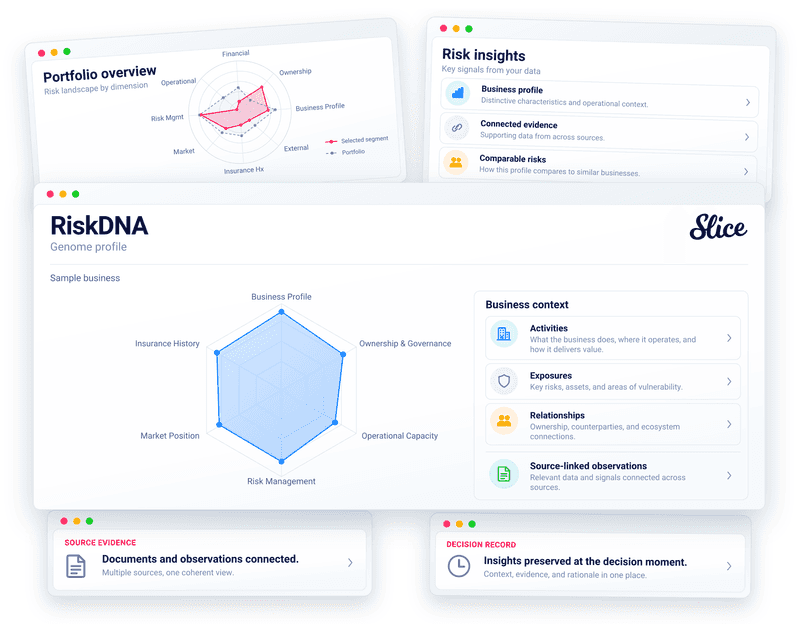
A persuasive explanation is insufficient if its evidence is unclear or another AI agent has a different interpretation of the business. Within Slice Mind, our platform for the AI-first MGA, RiskDNA gives people and AI agents a shared risk genome: a structured representation of a business's characteristics that they can inspect and reason over.
Sequencing organizes business evidence into named attributes, or genes. Related genes form chromosomes covering areas such as business profile, financial health, operational capacity and risk management. Together, the chromosomes form the genome. Each gene carries its source, date and confidence, so an observation or calculated attribute can be traced to its supporting evidence. Missing evidence and conflicting observations stay visible.
The surrounding conditions, which the architecture calls the exposome, include coverage, geography, distribution channel and market context. The business's characteristics remain distinguishable from the conditions in which they are assessed.
An insurance agent, an underwriter and an AI agent can therefore work from the same sequenced evidence: examine a source, challenge an interpretation and understand what has changed. As language models evolve, the genome remains a persistent, inspectable reference point.
Comparable risks need context
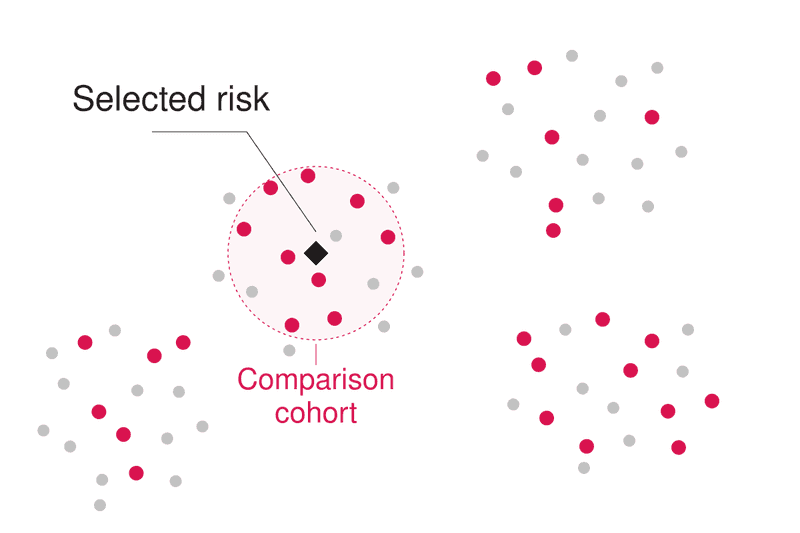
Think of a risk positioned in a constellation of other risks. Its neighbors share patterns across their risk genomes, viewed alongside relevant context. An ISO class, ZIP code and revenue band each tell us something useful, but businesses that share those labels can differ substantially across their chromosomes. Comparing sequenced characteristics across multiple dimensions can reveal peers that conventional categories overlook, as well as differences within an apparently uniform segment.
Bringing outcomes alongside those characteristics lets us investigate which comparable businesses have been profitable, which customers have stayed and what distinguishes them. Coverage, observation period and the maturity of loss experience determine whether the comparison is meaningful. Similarity provides evidence to investigate; it does not guarantee an outcome.
Underwriting can assess a submission against relevant precedents. Portfolio teams can investigate concentrations that cross familiar class boundaries. Distribution teams can explore where producer relationships align with the kinds of business the portfolio seeks. Each function applies its own objectives and constraints to a common risk foundation.
Preserve what was known when the risk was priced
The business we see at renewal may differ from the one we priced. RiskDNA preserves successive snapshots of the sequenced genome, together with the context and insights available at the decision moment. Later outcomes are linked to the relevant snapshot on a separate axis. We can examine what happened against what was known then, without rewriting the earlier record using hindsight.
Consider an illustrative case. A business originally described as performing workshop fabrication expands into installation at customer locations. Its website now advertises on-site work, and the business profile chromosome records that observation, dated, against a classification that still describes shop work. At the same time, competitive pricing softens. The changing activity and the changing market create different signals. Pressure to reduce price does not, by itself, establish that the exposure has improved.
Within the Slice Mind operating model, RiskDNA supplies the dated business evidence and comparable-risk context. AI agents coordinate the assessment across underwriting, portfolio, distribution and finance. Leadership can consider whether to hold price, change terms, recognize improved controls or redirect capacity. Once the direction is approved, agents and controlled services carry it through the relevant work without each department rebuilding the case.
The live sequence and lifecycle record provide a foundation for this work. We are developing the dedicated drift capability to compare current risk with the priced-moment snapshot, explain the change and assess its significance against relevant outcomes.
A glass box makes the evidence inspectable
Named genes and chromosomes give AI agents, and the people working with them, a structure they can inspect, with sources, dates, uncertainty and conflicting evidence attached. They can examine the evidence behind an insight and the context of a decision. That is the glass box: transparency in the risk genome and its supporting record. It does not imply that the internal workings of an LLM are fully explainable.
Governance connects evidence to authority. AI agents need defined responsibilities and permissions, with accountable people responsible for material decisions. Controlled services validate proposed actions, while records support examination of what was known and what was done. Preserving evidence and versions also supports our work toward more rigorous decision replay and repeatability. Drift detection, replay and repeatability all have to earn their decision value through evaluation rather than be assumed from the presence of an audit log.
The same discipline applies to learning. An outcome or correction becomes evidence for an evaluated change. Product, engineering, underwriting and model stewardship need a common process for examining cases, testing alternatives and releasing improvements.
An operating model for the whole MGA
We launched Slice Mind in 2019. In April 2025, we deployed our first platform using AI agents and large language models, or LLMs. Those milestones mark an evolution from our early intelligence capabilities to agents participating directly in insurance operations.
Today, Slice Mind brings together AI agents that coordinate and carry out work, RiskDNA, which sequences a business into a risk genome, and Insurance Cloud Services, or ICS, which provides controlled insurance transaction services. They are parts of one system, connecting risk intelligence with the operation through which insurance is delivered.
That system reaches beyond underwriting into agency management, regulatory reporting, licensing, taxes and state fees, finance, sales and marketing. A faster quote creates lasting value only when the surrounding business can issue, service, account for and renew the policy effectively.
Inserting a person into routine execution introduces that person's availability, queue and dependencies on other people. Even one handoff can recreate a workflow around human coordination. Our digital model was designed to avoid that dependency; AI agents extend our ability to execute within it.
People manage the system and own consequential decisions. They establish objectives, risk appetite and delegated authority, and resolve material uncertainty or trade-offs. AI agents carry routine work through the approved process. Required approvals remain decision gates.
This changes the management agenda. Leadership needs a connected view of production against plan, pricing adequacy, distribution performance, service, cash and enterprise risk. A change in appetite must reach the affected quotes, renewal priorities and broker communications. Management attention goes to the decisions that change direction or require judgment.
Reasoning connects to controlled execution
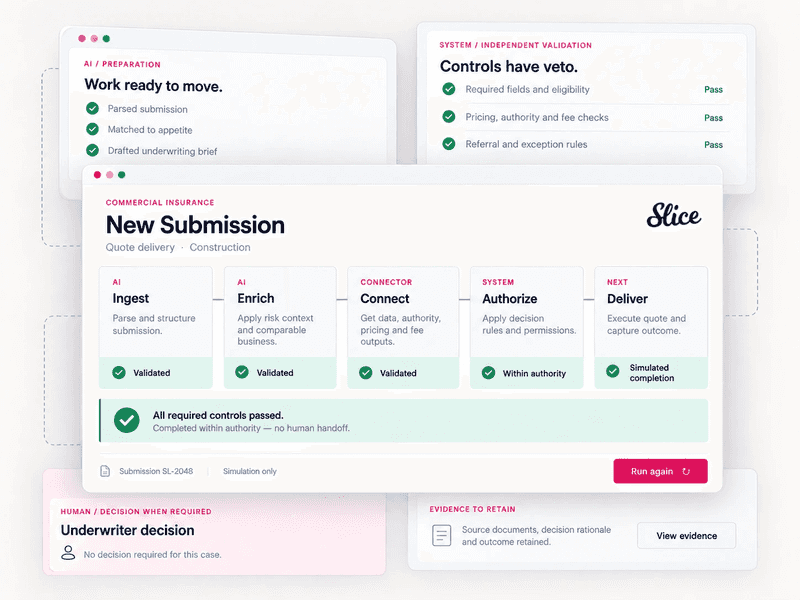
LLMs can interpret submissions, investigate information and help develop recommendations. ICS applies configured product rules and calculations, executes policy and payment transactions, and maintains the associated records. A proposed action must pass the relevant validation and authorization before execution. The language model cannot grant itself permission to bind a policy or move money.
ICS connects the intelligence to rating, policy issuance, servicing, premium and commission flows, and tax and reporting records. Reusing these services lets AI agents work through established controls. New reasoning capabilities can be introduced while retaining dependable transaction rules and records.
Putting the genome to work
The economic opportunity follows from these connections. Reusing risk context can reduce repeated investigation. Coordinated execution can shorten waiting time and reduce rework. Shared transaction services can make expansion into additional products or partner programs more repeatable. The appropriate measures include cost to serve, cycle time, risk performance, producer productivity and control effectiveness, assessed together as the business grows.
Our strategic direction is to build on the same operating foundation across our own insurance business and partner deployments. Each deployment must respect its data rights, carrier authority, product rules and jurisdictional requirements. Slice Mind can also incorporate human workflow steps for partners whose operating models call for them. Within those boundaries, reusable services and evaluated learning offer a path to growth without reconstructing the operating machinery for every program.
That is the purpose of Slice Mind: helping people and AI agents reason over a shared risk genome, with insights and context, then putting that understanding to work in the business of insurance.
Where does your business still repeat the same risk investigation or wait for work to move between teams?
If you’re a carrier, MGA or program partner, bring us one underwriting or operating challenge. Let’s explore where shared risk intelligence and controlled execution could help, what implementation would require, and how success should be measured.
